You wouldn’t think ’80s punk rock, traditional vocal jazz, electronica, early-twentieth-century Egyptian pop, Ornette Coleman free jazz, and contemporary experimental music could have much in common or mix well with each other in a song. But they all live together quite amicably in the fertile musical mind of Nadah El Shazly.
El Shazly is a dazzlingly talented Egyptian singer, composer, producer, and instrumentalist who has at one time or another played or listened to those musical styles, and she incorporates many of them into her own lush, atmospheric, disconcerting, multimelodic, traditional-experimental music. Her oddly beautiful mixtures of those diverse musical streams (along with her magnificent voice) have been fascinating listeners in Cairo, Canada, and U.S. Midwest towns like Fargo and Iowa City, which she passed through as part of a North American tour in the spring of 2019.
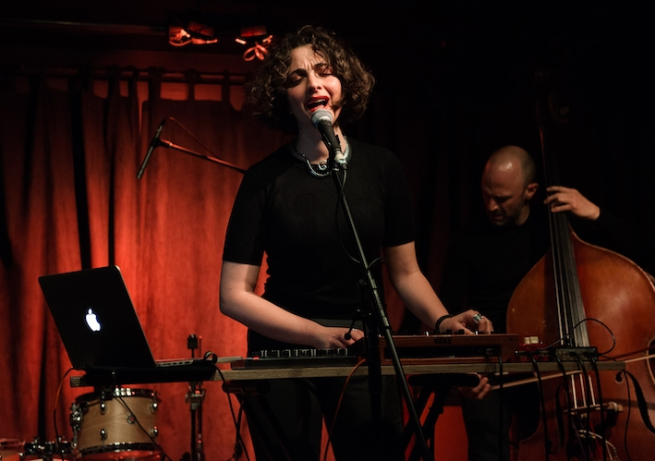
On the second stop of that tour, at the Burdock Brewery Music Hall in Toronto, El Shazly stood on the tiny stage with her keyboard stand, backed by saxophonist and drummer Devin Brahja Waldman and double bass player Thierry Amar, and proceeded to completely awe and transfix the audience as she played pieces from her debut album, Ahwar (2017). Its six tracks—five originals and a completely reimagined version of a popular song by Egyptian singer Sayyid Darwish (1892–1923)—incorporate modern and traditional music in fresh and wholly unexpected ways.
El Shazly’s involvement with music began as a child in Cairo, where her mother signed her up for piano lessons. When she discovered her voice, things progressed rapidly. “Growing up, I thought everyone could sing, I didn’t think it was something special,” she tells me. “I was playing the piano and then I started singing, and everything followed from there. I wanted more and more. I wanted to play more instruments and I wanted to try and write lyrics, I wanted to compose and . . . I’m very greedy!”
That exuberance and openness to the different kinds of music she heard over the Internet led to El Shazly performing Misfits covers in a Cairo punk band with her friends, and then, later, vocal jazz classics in hotel bars.
“I tried different things all the time, I didn’t stick to one thing or another,” she explains. “I was still trying to understand the relationship between what you like, what you want, what people are playing and doing as musicians, and what kind of work you can get as a musician. I was open to experiencing different things and keeping my eyes open for different opportunities. I was just trying everything.”
Eventually El Shazly started writing her own songs and playing them in small venues in Cairo. “There wasn’t a clear plan for an album, I just wanted to write pieces and perform them live,” she says. “That was the first step.” She tried different instrumental and composing approaches, slowly figuring out what worked best. “Because I started on piano, there are a lot of things I compose on the keyboard. I’m sure it would be different if I’d started on guitar. But I’m also trying to keep some loyalty to the song, to the way I hear it, not necessarily through an instrument. I figure out what instruments are closest to something I’m hearing, then I try and bring it to life.”
As she performed regularly in Cairo, El Shazly initiated a writing process that involves altering the tracks every time she plays them, keeping her work fascinatingly fluid and constantly evolving. “I kept performing pieces—working on them, developing them, trying out different ideas at different shows—until I was ready to say, ‘OK, what’s next?’” she explains. “It actually took a long time. I didn’t work very quickly.”
She began recording tracks on her computer, expanding her range to incorporate various electronics as well as stringed instruments like the Turkish saz. “I’d record something on a keyboard or a stringed instrument, then sing on top of it and process it. It’s different from one piece to another. I don’t think there was a moment when I discovered electronic music, because everything is electronic. But what I did discover was the software, the Pro Tools and Ableton and stuff that makes you more independent as a composer and allows you to try different ideas and try arranging, and that was great.”
For the track “Barzakh,” which dates back to her earliest Cairo performances, El Shazly mixed multiple voices and electronic beats with a traditional oud and a sample from a recording by the Egyptian singer Abd Al-Hay Hilmi, who died in 1912. Her song changes gears several times, but it works.
“I was with a friend of mine, Kareem Taylor, who was playing the oud,” she recalls. “He did this riff, and I started singing the main vocals, and it gave me this feeling of a big swing. The middle is very different from the way it starts, [which is] with an electronic beat. For me it made total sense that they were together, and at the end there’s another arrangement with the choir and the double bass. It’s one of my favourite pieces on the album, and one of the closest to me, because I did the middle part a long time ago and I never knew where it would fit, but I think it really fits this piece.”
In addition to Arabic, El Shazly speaks English, French, and German, but she worked with a translator on the album booklet to make the Arabic lyrics meaningful for English listeners. “You don’t feel that it’s translated, because it’s not word for word—it’s the feeling and the meaning,” she says.
The title, Ahwar, means “marshland” in English—sort of; but El Shazly says it’s really about a journey through a confusing mist or fog: “It’s like an invented place, and each song is an exploration of a different corner of this place. The songs build on each other. It’s not really about being lost in the marshland. It’s more like if you don’t know the place you’ll get lost, but if you know it you won’t get lost. So it’s about taking steps and not being scared inside this place, being able to look at it and even looking at a monster and not being scared by it.”
The lyrics of these songs are brief, even sparse—for “Mahmiya (Protectorate),” they are simply: “There was a protectorate / youthful sleep / bullets of silk / In your absence my ribcage expands / Protected.” “Most of the time vocal lines come more quickly than lyrics, so I would just sing whatever words came and then rework them,” she explains. “When I’m singing, I know exactly what I want to say, but the words are not ready. So I take more time with the lyrics than the music. But there were other instances when the lyrics were coming at the same time—so it depends on the song.”
At some point Nadah El Shazly discovered a style of Egyptian pop music that had fallen out of fashion—vocal music from the 1890s through the 1920s—and it affected her so deeply that it ended up transforming the way she thinks about music, improvisation, and performance.
“In Egypt, when people listen to old music, it’s from the ’40s to the ’70s,” she says. “But I came across an earlier singer called Abdel Latif Al-Banna, and fell in love with him. I realized that the first generation of this music was in 1890, and that there was a second and third generation of similar composer-singers, and I started reading and listening to different stuff and just delving into it and thinking, What is this music? How come no one told us about these singers, and how come they’re not played on the radio, or anywhere? It was fascinating to listen to these pieces, because they revealed the dynamic of how musicians played together at that time, and the liberty that each musician had within an ensemble to play and drift off and have their own interpretations become part of it. It makes basically every musician a composer, and I like that.
“It was very inspiring, though I’m not trying to recreate this music in any way, because I would fail miserably. It’s from a hundred years ago. But it influenced me——how I think about the dynamic between the musicians and to what extent there is liberty to interpret the lines in the pieces, and really how I think about music in general.”
El Shazly has called this music futuristic, despite its advanced age. “It sounds timeless to me,” she says. “I don’t know if I’m being too romantic about this era, but I think from the perspective of today it’s very liberating to hear this music. I think it has more to say about how things might sound in the future rather than just being old and frozen in time.”
Another kind of music that has a timeless quality, or at least a time-standing-still quality, is the free jazz played by Ornette Coleman, whose influence can be heard in the cascading, mesmerizing waves of wind instruments on “Koala,” cowritten with her friend and fellow Cairo musician Maurice Louca. “Maurice brought Skies of America and other Ornette albums back from his travels, and I listened to them and I was mind-blown,” El Shazly says. “I heard a very strong connection between that and the 1920s and 1890s music I was listening to, the aesthetic of it that I really appreciated. There was a strong link for me.”
Multi-instrumentalist Sam Shalabi, a linchpin of the Montreal music scene, worked with El Shazly on Ahwar, as well as on his projects Land of Kush and Karkhana. He finds a through line not just from Coleman to Arabic music, but also to punk. “The connection between Ornette Coleman and punk isn’t so bizarre—they both have a kind of exploratory quality,” he says. “One of the interesting things about free jazz is that there’s not much emphasis on structured harmony. It’s not focused on chords, and that’s also common in Arabic music. It doesn’t have a lot of complicated chordal structures, it’s monophonic music traditionally, all around the melody. There’s never been complicated harmonic movements in Arabic music. Also, Ornette often played music that is microtonal, and a lot of Arabic music is microtonal as well, with a focus on melody. I think that’s partly why that stuff resonates with Maurice and Nadah.”
The creative collaboration that grew out of El Shazly’s friendships with Louca and Shalabi was an important element in the making of Ahwar. She and Louca knew each other from the close-knit Cairo music scene, and he became a fan after seeing her solo show. “The first thing that struck me, of course, was her voice—it’s such a beautiful voice,” he says. “But I could tell that she had a unique sound—very adventurous. She was working on her album and she asked me to help her, and I was excited to do it. I was thrilled to do it.”
Louca cowrote several songs on Ahwar, and worked on arrangements with El Shazly, who recalls, “It’s fun working with Maurice, because we connected in a musical place that was very fertile—you just want to do more and more and more.” One of their most beautiful collaborations is “Koala,” which was written in five minutes. “I was playing the keyboard and I had this idea of layering all these keyboard lines on top of each other, and I just kept telling him, ‘Record, record, record!’ and I did them all in one go. If you keep listening to it for a long time you don’t get bored, because the lines are very different from each other and they interact with each other differently with time.
“And then Sam had more ideas for it, with the violins adding this layer that totally changes the movement, and guides the keyboard lines to different places, because they play very long notes that completely change the mood of the song. So we kept taking it further and further. It was really fun, because the three of us worked on the composition and arrangement together.”
El Shazly and Shalabi first met at a party in Cairo, where they talked about music and Montreal, and then he came to one of her shows and recognized her as not just a friend but a kindred spirit. “At that time I was listening a lot to Land of Kush,” she says, “and I was blown away by everything about it—the playing, the compositions, the lyrics, everything. When I met Sam I was already working on my album, and I’d started collaborating with Maurice. And I had this idea of collaborating with Sam and working with musicians from his world, from Land of Kush, to interpret the pieces, because it was so inspiring to listen to them. And I felt a strong connection between what I was trying to do and what Sam was doing.”
Shalabi first saw El Shazly play in Cairo at 100 Copies, a venue for experimental and alternative music. “It was a solo show,” he recalls, “and I was really impressed by what she was doing. We became friends and started getting together to play and talk about music. She was kind of slowly putting her songs together. She had been to Montreal and was into Land of Kush, and I proposed the idea that it would be interesting if she sang with that project, or worked with those musicians, and she thought that was a good idea, so we came up with a scheme to bring her to Montreal.
“With Nadah and I, there was an immediate connection,” he adds. “She is a very open, curious person, and she has an understanding and respect for traditional music. My desire was to work with Arabic musicians on something that was not traditional music. She was also putting her tentacles out to try and do something a bit more experimental. So we connected in that way. She’s willing to entertain some ideas that seem bizarre or wouldn’t normally make sense, and that resonates with me. It’s just been a very intuitive and easy working relationship.”
Ahwar was recorded mostly with engineer Thierry Amar in Montreal, where Shalabi drew from his musician network to add multiple layers to El Shazly’s tracks: guitar, piano, keyboards, electronics, synths, flutes, clarinet, alto and baritone sax, harp, violin, viola, double bass, drums, oud, tabla, trumpet . . . even a six-man choir. Quite a change from her original keyboard and voice.
“It was thrilling!” she raves. “And I learned so much from the experience. I feel very lucky that I had the chance to work on something like this as my first album. It makes me think that everything is possible with music. It was really mind-blowing to stand in the studio, especially such a beautiful studio, and have all of that. It was unforgettable.”
With all those instruments adding colours and textures to the songs, listening to the album is a completely different experience from hearing it played live, either solo or as a trio, but then again, it changes every time she plays it. “It would be amazing to play with all the musicians on the album, of course. But there is something very exciting about working with different musicians each time, because you get to look at the pieces and arrange them differently,” she says. “It keeps morphing and changing, and that’s very exciting to me.
“Sometimes it takes a while to strip everything down and get to the core of the songs. I want to see what’s important and what’s not important to keep in order to have more fun with the material. And I’m trying to not entirely attach myself to the songs as they are on the album, so I can make them something else that belongs to the live performance. It’s fun for me, and I also think it’s fun for someone who knows the album to go and hear the pieces differently.”
Either way, creative improvisation is essential. “Yes!” she says. “I love it. It’s a great feeling to just play and be in the moment, to not feel attached to what you’re doing, but also be completely present. And to play with musicians you know well. The more you trust, the more you can drift off and know that someone will bring you back. It’s great.”
Nadah El Shazly had the chance to improvise with her friends when she contributed to three tracks on Carte Blanche, a split LP by Karkhana, a “free Middle Eastern music septet” that includes both Shalabi and Louca. “They had a residency in Malmö, Sweden, last year and they invited me to come and sing with them,” she says. “It was great, because the way they work is they press “record” and they improvise. It was really fun to do that with a bigger group and just go with it. And I really like the result.”
She will also appear on Land of Kush’s upcoming album, Sand Enigma, to be released on Montreal’s Constellation Records on November 8, 2019. Her performance in the world premiere of Sand Enigma by Land of Kush at Toronto’s Aga Khan Museum in early 2018 electrified the audience, eliciting rave reviews and demand for her 2019 solo tour. “When Sam asked me to sing with Land of Kush, that was like a dream,” she smiles. “And by that time I had already met many of the musicians because they had worked on my album, so it was like a continuation of something that had already started.”
El Shazly is working on new songs, but she won’t talk about them, or play them live yet. Yet there’s no doubt she will find new ways to enthrall us. “They’re still very unfinished,” she says. “I’m still in the early process. It’s a different direction, but it’s difficult to talk about because I still haven’t heard it fully; it’s not there yet. There will be different arrangements, maybe different collaborators. A new adventure.”