Electronic music composers and pit viper snakes both create dramatic sounds that remind the listener of something that is not actually there. The Western Diamondback, the most common rattlesnake in Texas, can sound like a swarm of insects—or car radio static or steam escaping from a stovetop teakettle, depending on your imagination. The electronic music composer, found around the world in academic, concert, and nightclub settings, can sound like, well, a viper snake.
The composer and snake both intentionally use the resources at hand—or on tail—to create sound that causes the listener to react.
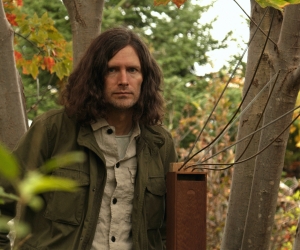
In the case of acclaimed Greek composer Panayiotis Kokoras—currently the Regents Professor of Music Composition at the University of North Texas in Denton, Texas, where he’s served as CEMI (Center for Experimental Music and Intermedia) director since 2016—the reaction to Viper Snake, his eight-minute composition for two percussionists and electronics, has been welcoming (the opposite reaction one would have to hearing a snake hiss, whistle, or rattle nearby).
Composed for the contemporary percussion ensemble Synergein Project, Viper Snake received its world premiere in November 2021 at IX Ciclo de Música Contemporánea de Lugo, MIHLSons-XXI in Spain, and has been performed a few times since then and earned admiration from juries, including the jury for the 2025 Musicworks Electronic Music Composition Contest, which awarded the composition first prize.
Kokoras started playing classical guitar when he was ten, and after several years of undergraduate music studies in music performance, theory, history, and composition, he went to the University of York (U.K.) for his MA in music and PhD in composition. Although academia was, and still is, his comfort zone for research and creative work, his interest in electronic music was sparked by popular culture, specifically the music of his globally loved countryman Vangelis.
“He and others from the era were my heroes because they were using technology in a very new way,” he told me during an online conversation shortly after he received the news about his composition winning first prize. “What they were doing with synthesizers and other electronics in the ’80s and ’90s was still very new. So much of the film music was very orchestral, full of emotion and fantastic sounds.
Despite closing his guitar case, Kokoras has continued to be inspired by and work with physical instruments. For Viper Snake, he used tools and his hands to modify existing instruments and invent new ones, and followed a compositional process of trial and error—making new sounds, improvising, and listening back to maximize the musical potential. He documented the process in various ways—photographs, video tutorials, and audio and video performances—so the piece could be fully transmitted to new players. “It’s like folk music in a way,” he said. “The performance notes are multimedia. So I provide videos, like how to modify or build the instrument, how do you play that sound? You see it, and you do it.”
The instruments used in Viper Snake are a modified ratchet, a custom-made daxophone, and a stick Kokoras designed and used for both instruments. It has two main sections, each with multiple subsections, and one shorter section in the middle of the piece called “Fantasia,” in which various field recordings are combined with the instrumental parts to create multiple timelines and spaces.
Kokoras has several compositions in his catalogue with titles referring to animals—Hippo, Rhino, Porcupine, Ape, and even Demonic Animal. “I love that connection with nature and with zoo musicology—the sounds that the animals make in their habitats—and I try to incorporate all these things in the piece. You may hear soundscapes that could sound like where this viper snake lives, and then fast, crackling sounds that might be a rattlesnake. We don’t know what kind of viper snake it is, but there are hissing sounds. I use this as a starting point.”
Working in this way, Kokoras says, connects him to something deeper than music culture. “I feel more like I’m a shaman, out there in the jungle when I play with these elements. I am reminded that music started out there. When people wanted to scare the lions, they would make lion sounds. They would imitate the sounds of rain when they needed rain.
“Then, at some point, not that long ago, this experience was brought inside, and for a few centuries we closed the doors and disconnected ourselves from nature. Now that we have all this media, we can go to nature, record sounds, and bring nature into the console.
"I feel connected to this lineage somehow. So when you listen to Viper Snake, it could be a kind of ancient ritual you are feeling."